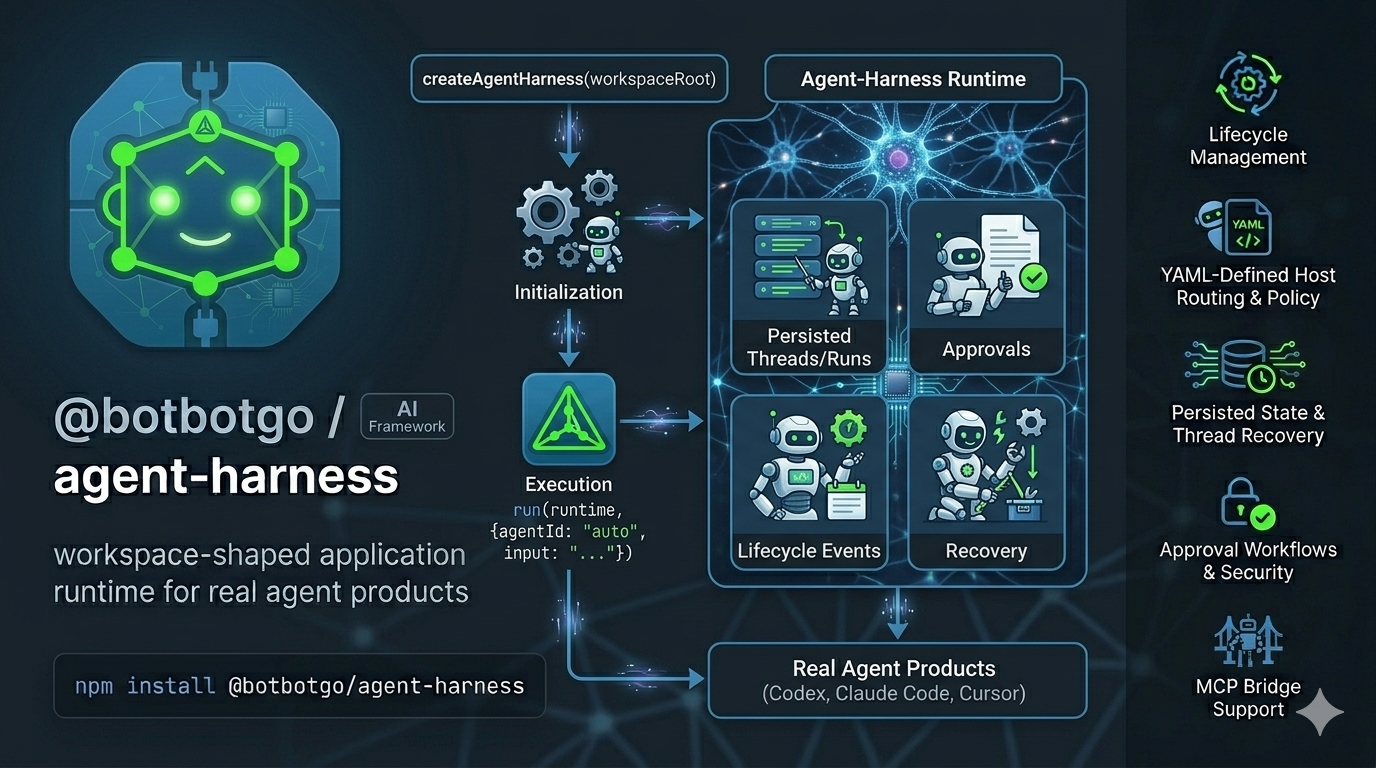
Where agent-harness fits定位与对比
Comparison docs show how agent-harness relates to people-facing agent products, execution frameworks, and workflow automation tools.
对比文档说明 agent-harness 与面向人的智能体产品、执行框架和工作流自动化工具各自的定位与关系。
Ship quickly. Prove value. Scale with control.
快速接入,验证价值,再稳步扩展。
agent-harness is the workspace-shaped runtime for multi-agent products. It adds approvals,
recovery, inspection, operator controls, and protocol-ready surfaces on top of your agents—so you ship
operable software, not only prompts. The harness owns the product runtime layer around your existing
execution stack.
agent-harness 是以工作区为单位的多智能体产品运行时:在智能体之上提供审批、恢复、运行检查、运维管控与协议接入,帮你交付能长期运维的系统,而不止于调模型。harness 负责现有执行栈之外的运行时层。
Recommended method: one sentence to let your coding agent build a complex runtime application推荐方式:一句话让 coding agent 构建复杂运行时应用
Follow https://botbotgo.github.io/agent-harness/SKILL.md to build a stock deep research runtime application.Alternative method: start one runtime in a few lines另一种方式:几行代码即可启动运行时
import { createAgentHarness, request, stop } from "@botbotgo/agent-harness";

const runtime = await createAgentHarness("/absolute/path/to/workspace");
const result = await request(runtime, {
  agentId: "auto",
  input: "Explain what this workspace is for.",
});
console.log(result.output);
await stop(runtime);
What to align on before you scale
上线前值得对齐的三点
Yes—persisted requests, approvals, recovery, audit-friendly records, and operator tooling are first-class, not bolted on after the demo.
是。持久化运行记录、审批、恢复、审计与运维能力均为内置能力,而不是演示后再打补丁。
Point at a workspace, wire YAML, connect tools and MCP, and stand up approvals, recovery, and inspection behind a small API—without building bespoke runtime plumbing.
指定工作区目录,写好 YAML,接入工具与 MCP,通过精简的 API 即可获得审批、恢复与可观测能力,无需从零搭建运行时底座。
Persisted requests and sessions, human approvals, restart-safe recovery, protocol surfaces, and operator-facing records you can inspect right away.
持久化的请求与会话、人工审批、进程重启后仍能恢复运行、协议侧接入能力,以及可查可管的运维台账。
In practice: one small API plus YAML assembly; execution stays upstream while persistence, approvals, and recovery stay runtime-owned.
落地方式:精简 API + YAML 装配;执行语义留在上游,持久化、审批与恢复由运行时统一托管。
npm install @botbotgo/agent-harness
More detail in the developer docs below.
更多说明见下文开发文档。
At a glance: you ship a stable runtime contract quickly, with operating controls built in from day one—not a framework science project.
快速了解:能尽快交付稳定的运行时契约,运维能力从第一天就内置——而不是长期堆原型、拼框架。
Commercial support: optional help with deployment, launch, and operator handoff after you decide the runtime fits.
商业支持:方案合适后,可按需选购部署指导、上线协助与运维交接等服务。
Lead with the practical: how the runtime turns a workspace into an operable product layer—then approvals, recovery, protocol bridges, and operator control.
从「工作区如何变成可运维的产品层」讲起,覆盖审批、恢复、协议桥接与运维控制,用可落地的机制代替抽象定义。
Comparison docs show how agent-harness relates to people-facing agent products, execution frameworks, and workflow automation tools.
对比文档说明 agent-harness 与面向人的智能体产品、执行框架和工作流自动化工具各自的定位与关系。
Requests, sessions, approvals, events, and artifacts are treated as stable runtime records rather than incidental backend output.
将 requests、sessions、approvals、events、artifacts 视为稳定的运行时数据,而不是执行引擎旁路的临时输出。
The runtime owns interruption handling, restart recovery, approval continuation, and operator-facing inspection.
由运行时处理中断、重启恢复、审批续跑与面向运维的可观测能力。
ACP, A2A, AG-UI, and runtime MCP are exposed as stable transport surfaces instead of one-off integration demos. MCP stays the resource/tool plane, A2A stays the agent-to-agent task bridge, ACP is the primary editor-or-client boundary, and runtime MCP exposes the operator control plane outward.
将 ACP、A2A、AG-UI 与 runtime MCP 作为稳定的对外接入面,而不是零散的集成示例。MCP 负责连接资源与工具,A2A 负责智能体平台之间的任务协作,ACP 是编辑器或客户端接入运行时的主边界;runtime MCP 则把运维控制能力以统一接口对外暴露。
Routing, models, tools, MCP, maintenance, and policy live in YAML so complex runtime assembly stays explicit and reviewable.
路由、模型、工具、MCP、维护与策略写在 YAML 里,复杂装配一目了然,便于评审。
Execution frameworks stay upstream-owned; adapters use them deeply without redefining a second agent framework.
执行框架仍由上游定义;适配器深度复用其能力,不再自造一套智能体框架。
Legend: ✅ (default) · ⚪ (opt-in / middleware-backed) · ❌ (not in public runtime contract).
图例:✅(默认) · ⚪(可选/依赖中间件) · ❌(不在公开契约中)。
Execution frameworks own agent execution. n8n owns workflow automation. agent-harness operates the application runtime layer for multi-agent products.
执行框架负责智能体执行语义;n8n 侧重工作流自动化;agent-harness 提供多智能体产品所需的运行时层。
Use this matrix after you have a rough picture of agent-harness—it helps you validate fit, not replace the intro.
对 agent-harness 有大致了解后再用本表做选型对照;它不能替代入门阅读时的概念说明。
The difference is not replacing execution engines. It is the operating layer that makes those engines production-ready.
重点不是替换执行引擎,而是让现有执行引擎具备可上线、可运维、可恢复的应用运行时能力。
Beyond mechanics, the product question is what you and your operators can count on every day.
除了机制本身,更要看清你和运维团队每天都能依赖哪些能力。
A deliberately small API around `createAgentHarness`, `request`, approvals, inspection helpers, memory, artifacts, and stop.
围绕 `createAgentHarness`、`request`、审批、查询辅助接口、记忆能力、产物读取与 `stop` 组织成的一套精简 API。
Approval queues, recovery, queueing, runtime health, event inspection, and operator overview belong to the product runtime.
审批队列、恢复、排队、运行时健康、事件排查与运维总览均由产品运行时负责。
Agents, catalogs, tools, skills, MCP, and policy are assembled through a workspace-shaped configuration model.
以工作区形态的配置模型装配 agents、catalogs、tools、skills、MCP 与策略。
External clients can integrate through ACP, A2A, AG-UI, and runtime MCP without redefining the product runtime surface. The thinnest local starter is ACP over stdio for IDE or CLI sidecars.
外部系统可通过 ACP、A2A、AG-UI 与 runtime MCP 接入,无需再造一套产品运行时模型。若想从最轻量的本地接入方式开始,优先使用面向 IDE 或 CLI 侧车进程的 ACP stdio。
Enterprise internal agent runtime, coding-flow runtime, protocol bridge runtime, and governed multi-agent applications.
企业内智能体运行时、编码类长流程运行时、协议桥接运行时,以及受治理的多智能体应用。
Commercial support covers deployment guidance, production hardening, and team handoff when you want help beyond the open-source runtime—see default scope and exclusions below.
需要部署协助、生产加固或团队交接时,可选择商业服务;下方说明默认包含的范围与需单独约定的部分。
Treat the runtime as product infrastructure: start with one measurable workflow, keep humans in the loop where the business needs them, plug into tools teams already use, and ship observability alongside the workflow.
把运行时当作产品基础设施:从一条可度量的流程做起,在业务需要处保留人工环节,接入团队已在用的系统,并与流程同步交付可观测性。
Pick one team and one repeated task to improve before broad “transformation” scope creep sets in.先明确「哪个团队、哪条重复任务要改善」,再扩展范围,避免空泛的转型清单。
Build approvals, escalations, and manual takeover into the first version so pilots can touch real risk boundaries safely.第一版就纳入审批、升级与人工接管,试点才能覆盖真实风险边界。
Surface answers, summaries, tickets, and approvals in email, docs, chat, or ticketing—where work already happens.把回复、摘要、工单与审批放在邮件、文档、聊天或工单等现有工作界面里,降低切换成本。
Make it possible to inspect what happened and intervene when something goes wrong—before you scale usage.在扩大使用面之前,先能看清发生了什么并在异常时介入。
One department, one owner, and one measurable target is a solid base for the next deployments.先锁定一个部门、一个负责人与一个量化目标,再复制到更多场景。
Shared runtime infrastructure keeps later integrations cheaper while outcomes stay tied to concrete business metrics.共享同一套运行时基础设施,后续接入成本更低,结果仍可落到具体业务指标上。
These scenarios are the clearest places to apply the runtime after you understand how it sits next to your execution stack.
在了解运行时与现有执行栈如何分工之后,下列场景最能体现 harness 的用武之地。
Grouped by lifecycle, invocation, events, inspection, and approvals.
按生命周期、调用、事件、查询与审批分组。
Feature snapshot: aligned to public contract v0.0.77 and implemented in the exported package API used below.
能力快照:与公开契约 v0.0.77 一致;下列示例来自当前导出的包 API。
Start with the chapter-based developer docs. They include a side-by-side comparison that shows where the harness sits relative to people-facing agent products, execution frameworks, and workflow tools.
从章节化开发文档开始,覆盖接入、配置、运行、排障、API 与协议说明;并列对比页帮助你在选型时理解 harness 与相关技术栈的差异。
Docs
文档
A chapter-by-chapter documentation path covering getting started, the runtime model, YAML, extensions, operations, release workflow, and the public runtime surface.
按章节组织的开发文档,带你从起步一路看到运行时模型、YAML、扩展、运行维护和发布。
Docs ZH
中文文档
A Chinese version of the same chapter-based docs, organized for continuous reading from setup through release.
中文开发文档入口,内容和英文版对应,方便直接按章节连续阅读。
Comparison
Public technical comparison of people-facing agent products, execution frameworks, workflow tools, and the harness runtime layer.
对比
并列比较面向终端用户的智能体产品、执行框架、工作流工具与 harness 运行时层,便于选型时理解差异。
API
Lifecycle, invocation, approvals, memory, artifacts, and transport adapters in one reference.
API
把生命周期、调用、审批、记忆能力、产物读取和传输适配器集中放进同一个参考入口。
Protocols
ACP, A2A, AG-UI, and runtime MCP explained as stable user-facing entry points.
协议
将 ACP、A2A、AG-UI 与 runtime MCP 说明为稳定的对外入口,而不是零散附录。
Changelog
Browse the same history as RELEASE_NOTES.md—Unreleased work and shipped versions in one
scrollable page.
更新记录
与 RELEASE_NOTES.md 同步的版本历史,便于在文档站连续阅读未发布变更与已发布版本。
A practical first step: read the docs to confirm the runtime model fits your product, then reach out if you want help with deployment or launch.
可以这样开始: 查阅文档,确认运行时模型与你的产品目标一致;需要部署或上线支持时,可通过下列方式联系。
info@easynet.world GitHub Issues Contributing贡献指南 Code of Conduct行为准则 Security安全说明 License许可协议